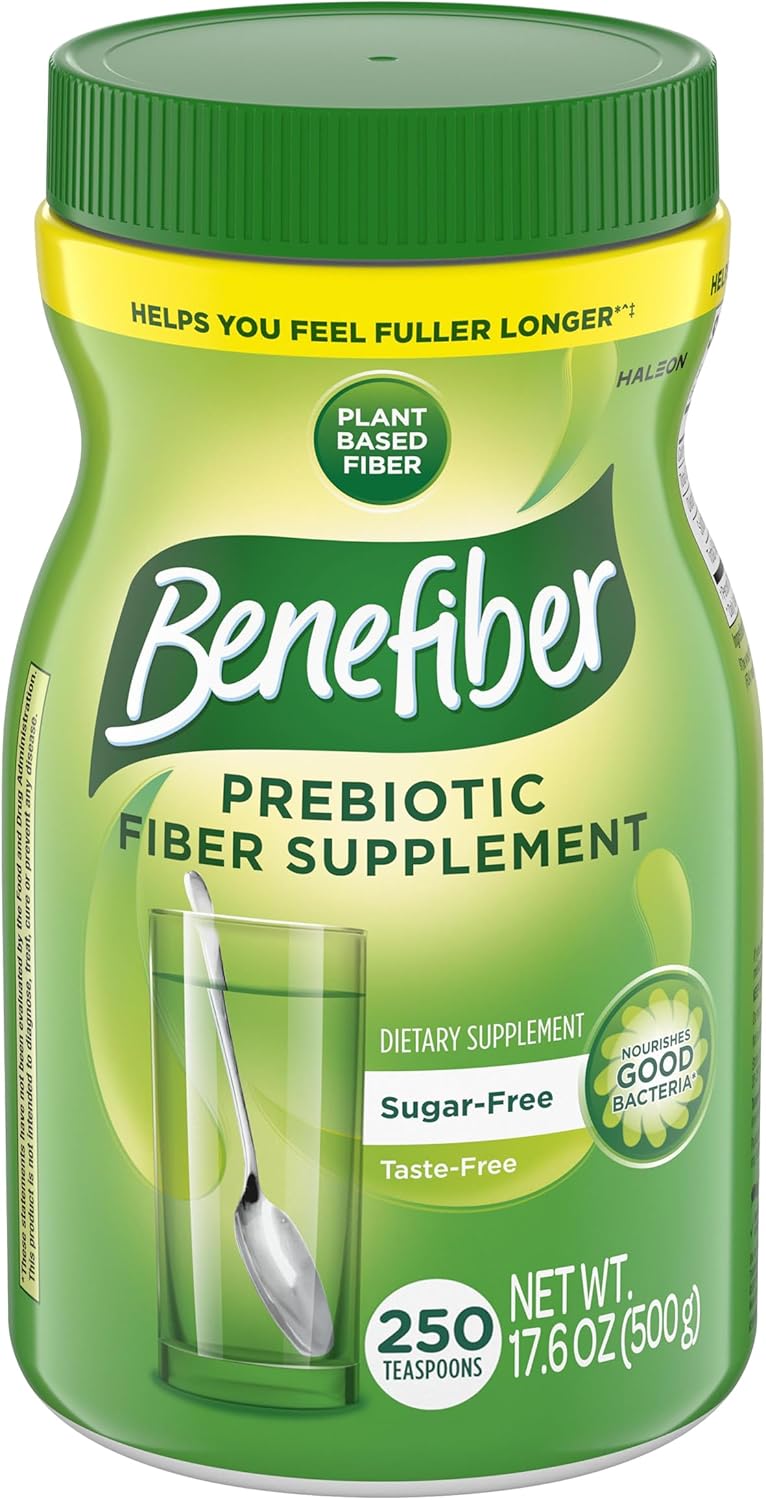
Benefiber Daily Prebiotic Fiber
Benefiber is a clear, taste-free fiber supplement made from wheat dextrin. Dissolves completely in beverages and soft foods, making it easy to get your daily fiber without changing your routine.
Effectiveness by Hemorrhoid Type
Best For
Not sure about your hemorrhoid type? Take our free assessment
Pros
- Completely taste-free
- Dissolves clearly - no grit
- Prebiotic benefits for gut health
- No sugar or sweeteners
- Easy to add to any drink
Cons
- Less fiber per serving than psyllium
- Contains wheat (not for gluten-sensitive)
- May cause bloating initially
How Wheat Dextrin Fiber Works: The Invisible Supplement
Benefiber's active ingredient is wheat dextrin — a soluble fiber extracted from wheat starch. Its defining characteristic is near-invisibility: it dissolves completely in liquid, has no taste, no color, no grit, and no thickening effect. For hemorrhoid patients who need daily fiber but refuse to drink a thick psyllium shake, wheat dextrin is the practical alternative.
Mechanism of Action
Like all soluble fibers, wheat dextrin absorbs water in the intestine, softening stool and promoting easier passage. Softer stools mean less straining during bowel movements — the primary controllable cause of hemorrhoid flare-ups. Additionally, wheat dextrin acts as a prebiotic, feeding beneficial gut bacteria. This may improve long-term digestive regularity. For a comparison of fiber types, see our fiber supplement selection guide.
Lower Fiber Per Serving
Benefiber provides approximately 3g of fiber per serving, but the soluble fiber content that directly softens stool is lower per gram than psyllium. This means Benefiber may require multiple daily servings to match the stool-softening effect of a single Metamucil dose. The trade-off for invisible dissolution is slightly less potency per serving.
Who Benefiber Is Best For (and Who Should Choose Differently)
Best Candidates
- Texture-averse users. If you've tried psyllium (Metamucil) and can't tolerate the gel consistency, Benefiber eliminates this problem entirely. It dissolves in coffee, water, juice, or food with zero detectable change.
- Users who want stealth supplementation. You can add Benefiber to cooking, baking, smoothies, or soups. Family members or children who need more fiber won't know it's there.
- Recurring hemorrhoid patients who need a long-term daily habit. Compliance is the key factor in fiber effectiveness, and a supplement you can't taste or feel is easier to take consistently.
When to Choose Something Else
- Gluten sensitivity or celiac disease. Benefiber is derived from wheat. While the manufacturer states it contains less than 20ppm of gluten (meeting FDA gluten-free standards), individuals with celiac disease should choose Citrucel (methylcellulose) which is truly gluten-free.
- Maximum stool-softening effect. If you need the strongest possible stool softening per serving, psyllium ( Metamucil) delivers more gel-forming fiber per dose.
- Acute constipation. Benefiber works gradually. For immediate relief during a hemorrhoid flare-up, a stool softener like Colace acts faster.
How to Take Benefiber and What to Expect
Dosing
- Mix 2 teaspoons in 4–8 oz of any non-carbonated beverage. Stir well — it dissolves in 10–15 seconds.
- Take up to 3 times daily. For hemorrhoid management, twice daily (morning and evening) is typical.
- Can be added to soft foods, oatmeal, yogurt, or used in cooking and baking without affecting taste or texture.
- Increase water intake by at least 8 oz for each serving — same requirement as all fiber supplements.
Timeline
Expect noticeable stool softening within 48–72 hours. Full regularity develops over 1–2 weeks of consistent daily use. Like all fiber supplements, consistency matters more than dose — daily use at a moderate dose outperforms occasional use at high doses.
Side Effects
Gas and bloating during the first 1–2 weeks are common as gut bacteria adjust. Wheat dextrin generally produces less gas than psyllium because it ferments more slowly, but some adjustment is still expected. Starting at half-dose for the first week minimizes this. See our fiber diet guide for tips on building fiber intake gradually.
Alternatives, Value, and Our Assessment
Alternatives
- Metamucil (psyllium) — More fiber per serving, stronger clinical evidence for hemorrhoids. Noticeable texture. Best for users who prioritize effectiveness over convenience.
- Citrucel (methylcellulose) — Less gas, gluten-free. Also dissolves well though not as invisibly as Benefiber. Best for sensitive stomachs and celiac patients.
- Dietary fiber increase — Beans, lentils, whole grains, fruits, and vegetables. No supplement needed. The most comprehensive approach, but requires sustained dietary change.
Price and Value
For approximately 62 servings, Benefiber has a per-serving cost comparable to Metamucil. At twice-daily dosing, the monthly cost remains moderate. For the complete fiber category comparison, see our fiber buying guide.
Our Assessment
Benefiber is the best fiber supplement for users who prioritize compliance through invisibility. The thousands of positive Amazon reviews reflect a product that delivers on its core promise: effective fiber supplementation with absolutely no detectable change to your food or drinks. For hemorrhoid patients who have tried and abandoned psyllium due to texture, Benefiber is the answer.
The trade-off is slightly less potency per serving compared to psyllium, and the wheat-derived ingredient excludes celiac patients. If you can tolerate psyllium's texture, Metamucil has stronger evidence. If gas is your concern, Citrucel is gentler. But for sheer ease of daily use, nothing beats a fiber you can't see, taste, or feel.
Best Fiber Supplement for Hemorrhoids
Compare all top-rated fiber supplements in our buying guide.
Related Articles
Frequently Asked Questions
Compare Similar Products
Metamucil Psyllium Husk Fiber Supplement
Psyllium fiber supplement to soften stool and reduce straining.
Colace Stool Softener Capsules
Gentle stool softener for easier bowel movements.
Citrucel Methylcellulose Fiber
Gentle fiber supplement that minimizes gas and bloating.
Not Sure If This Is Right For You?
Take our free 2-minute assessment to identify your hemorrhoid type and get personalized product recommendations.
Take the Free AssessmentAffiliate Disclosure: We may earn a commission when you purchase through our links, at no additional cost to you. This helps support our research and content creation. We only recommend products we believe are effective for the hemorrhoid types we've identified. Last updated: January 2026.